In modern manufacturing automation, end-of-line performance determines whether upstream efficiency translates into shipped product. You can invest in high-speed fillers, labelers, and inspection systems, yet still lose capacity if your case packers and palletizing systems are not engineered to function as a unified solution.
Case packers and palletizers sit at a critical transition point: the moment individual units become distribution-ready loads. When integration between these systems is incomplete or poorly specified, you see it immediately in reduced throughput, unstable pallet loads, excessive changeover time, and maintenance conflicts.
Understanding where integration typically fails allows you to plan a line that performs as designed.
Why Case Packer and Palletizer Integration Matters
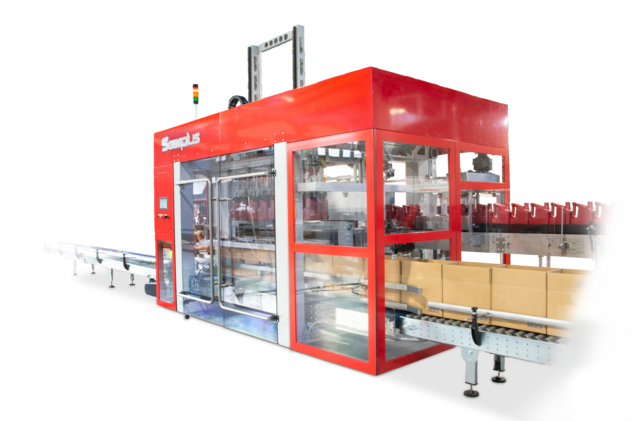
Case packers and palletizing systems handle distinct tasks, but they share a single production line. The case packer fills, seals, and ejects finished cases at a fixed rate. The palletizer receives those cases, arranges them into stable loads, and prepares them for shipment. Any mismatch in speed, orientation, communication, or physical layout creates a chokepoint.
You’ve likely seen the symptoms: cases piling up between machines, emergency stops triggered by misaligned transfers, and operators manually intervening to keep the line moving. These disruptions reduce your effective capacity and force you to choose between running slower or accepting higher rejection rates. Proper integration eliminates those trade-offs.
Challenge #1: Speed and Throughput Mismatches
One of the most common integration issues is speed misalignment. A case packer may be rated at 40 cases per minute, while the palletizer is configured to handle 35. On paper, the difference appears manageable. In practice, the result is chronic micro-stoppages, conveyor backups, and unplanned accumulation.
Throughput mismatches also emerge during ramp-up or deceleration cycles. If the palletizer cannot absorb surges from the case packer, cases begin to queue. Accumulation zones compensate temporarily, but prolonged imbalance increases wear on conveyors and creates unstable flow.
Challenge #2: Product Handling and Orientation Issues
Case packers control product orientation inside the case. Palletizing systems depend on consistent case geometry and flap integrity to build stable loads. If the case packer produces slight dimensional variation or inconsistent flap sealing, pallet stability suffers.
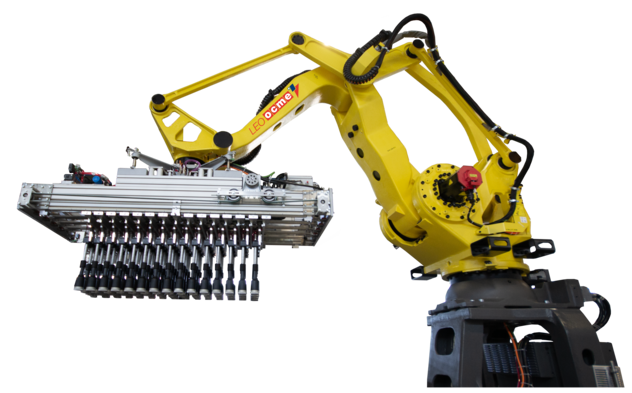
Orientation errors compound the issue. A rotated case may still pass through the conveyors but disrupt layer formation at the palletizer. Robotic palletizers are sensitive to positional variance; conventional palletizers rely on predictable case presentation for mechanical squaring.
Common causes include:
-
Inconsistent case forming upstream
-
Variable compression during product loading
-
Lack of orientation verification between systems
Challenge #3: Communication and Control System Incompatibility
Modern case packers and palletizers ship with embedded controllers that manage internal sequences, such as PLCs, motion controllers, or proprietary systems. Integrating those controllers requires a common language: fieldbus protocols, industrial Ethernet standards, or discrete I/O signals.
When vendors use incompatible protocols or proprietary networks, you need gateway devices, protocol converters, or custom programming to bridge the gap. Each translation layer introduces latency, diagnostic complexity, and potential failure modes. If the case packer sends a “case ready” signal 200 milliseconds before the palletizer polls its input, the case may pass undetected and trigger a fault downstream.
Control incompatibility extends beyond hardware. Software logic, alarm handling, and data logging must align. If the case packer logs faults in one format and the palletizer uses another, your maintenance team spends extra time correlating events during troubleshooting.
Challenge #4: Changeover Complexity and Downtime
Running multiple SKUs or packaging formats demands fast, repeatable changeovers. The case packer adjusts flap folders, sealing bars, and discharge timing. The palletizer reconfigures gripper spacing, pallet patterns, and layer heights. If those adjustments require separate setups, your changeover window stretches.
Changeover complexity multiplies when integration touches mechanical, electrical, and software layers. You swap a case format, update the packer’s recipe, but forget to load the matching palletizer pattern. The palletizer begins stacking the old configuration, and you catch the error only after the first pallet ships.
Challenge #5: Space Constraints and Layout Limitations
Facility layout often drives integration compromise. When case packers and palletizing systems are sourced separately, each machine may be optimized individually for its own footprint, not for the combined flow.
Space constraints create:
-
Excessive conveyor turns
-
Long transfer distances
-
Restricted maintenance access
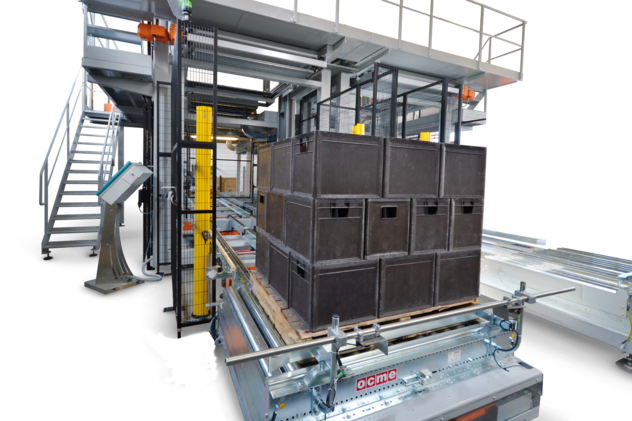
Poor layout can also complicate pallet discharge and forklift traffic. In distribution-focused operations, inefficient palletizer flow affects warehouse operations beyond the production floor.
Early collaborative layout planning allows you to position case packers and palletizing systems as a continuous flow path. That reduces conveyor complexity and simplifies safety zoning.
Challenge #6: Maintenance and Serviceability Gaps
Integration does not end at installation. Maintenance planning is frequently overlooked during system specification.
When different vendors supply machines, you may face:
-
Separate spare parts inventories
-
Disconnected service schedules
-
Conflicting troubleshooting procedures
Service technicians must understand both systems to diagnose line-level issues. Without coordinated documentation and training, troubleshooting becomes fragmented.
Integrated maintenance planning includes standardized components where feasible, aligned service intervals, and unified diagnostic access. That approach reduces mean time to repair and improves overall equipment effectiveness.
Best Practices for Seamless Integration
Successful integration begins before procurement. You define performance targets, SKU variability, and growth projections early. Equipment suppliers then engineer the case packer and palletizer as complementary systems rather than standalone assets.
Key best practices include:
-
Conducting line-level throughput simulations
-
Defining shared dimensional tolerances for cases
-
Standardizing control platforms and communication protocols
-
Aligning the changeover strategy across all formats
-
Designing layouts with maintenance access in mind
You also benefit from a single point of accountability. When one integrator assumes responsibility for both case packers and palletizing systems, performance gaps are addressed at the system level rather than attributed to individual machines.
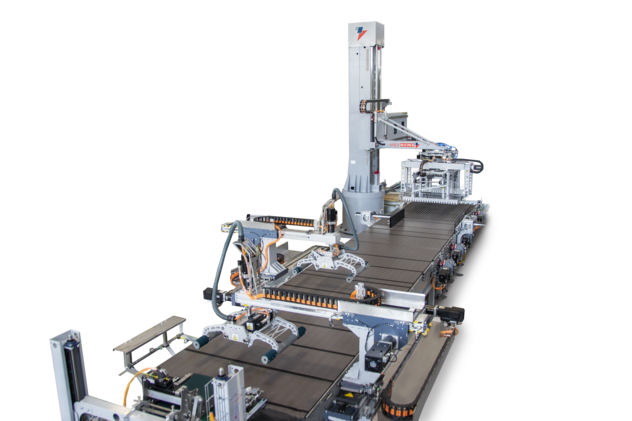
At OCME USA, we design case packers and palletizing systems as complementary components of a single end-of-line solution. Our equipment shares control platforms, communication protocols, and mechanical interfaces, eliminating the gaps that plague multi-vendor installations.
Our engineering teams perform throughput modeling before equipment leaves the factory. We match case packer discharge rates to palletizer infeed capacity and configure buffering systems that absorb natural cycle variations without triggering faults. When you specify product dimensions and SKU ranges, we validate handling compatibility and recommend orientation modules or transfer stations where needed.
OCME USA’s unified control architecture uses open industrial protocols and a common HMI framework. Operators manage both machines from a single touchscreen, view real-time performance data side by side, and execute changeovers through integrated recipes. Maintenance teams access diagnostic logs in a consistent format and order spare parts from a consolidated inventory.
When floor space is limited, OCME USA offers compact configurations and vertical integration options that maintain serviceability. Our layouts prioritize access to wear components, motors, and sensors so your technicians can perform routine maintenance without disrupting adjacent equipment.
Eliminate Integration Gaps With OCME USA
You chose end-of-line automation to solve capacity constraints, not create new ones. The difference between a line that meets design specifications and one that requires constant intervention lies in how well your case packers and palletizing systems function as a coordinated system.
If you’re planning a new installation or addressing persistent integration issues, start the conversation with a partner who engineers both machines to work together from day one.
Contact OCME USA today to discuss your facility’s manufacturing automation needs.