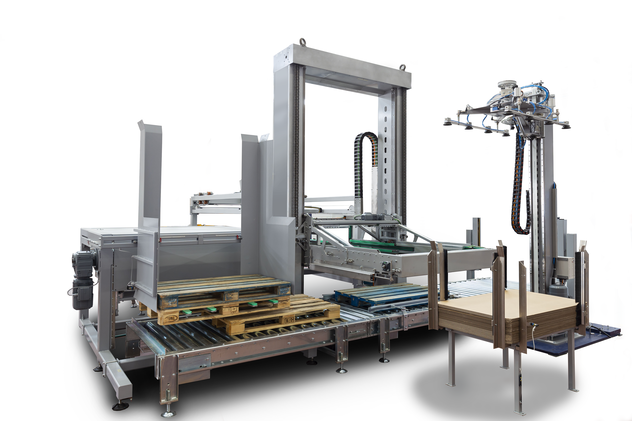
In high-speed production environments, palletizing is the point where upstream performance is either sustained or lost. When the palletizer falls behind, the entire line feels it: accumulation builds, operators intervene, and throughput drops below target.
These issues aren’t always caused by insufficient speed. More often, they come from mismatched equipment, inconsistent handling, or a palletizing system that can’t maintain performance across varying conditions.
That’s why selecting a palletizer requires more than reviewing specifications. It requires understanding how the system behaves under continuous load, how it integrates with adjacent processes, and how it performs when conditions aren’t ideal.
This guide focuses on those realities, helping you assess industrial palletizing systems based on real-world throughput, operational stability, and integration.
Understanding Your High-Speed Production RequirementsBefore evaluating palletizing equipment, you need a clear picture of how your line actually runs.
Define Your Production ParametersStart with measurable realities:
-
Actual cases per minute under normal operating conditions (not peak theoretical output)
-
Product dimensions, weights, and packaging variability
-
Pallet configurations and stacking requirements
-
Frequency and duration of SKU changeovers
-
Downtime events tied to end-of-line constraints
Underestimating throughput creates bottlenecks, while overestimating leads to underutilized capital and unnecessary system complexity.
Industry-Specific DemandsHigh-speed production environments span multiple industries, each with unique constraints:
-
Food and Beverage: High speeds must be maintained without compromising product integrity or hygiene compliance
-
Lubricants and Industrial Liquids: Require stable handling of heavy, sometimes irregular loads at speed
-
Distribution Environments: Demand continuous uptime with minimal operator intervention
In practice, high-speed success depends on how well the palletizer adapts to these constraints rather than just how fast it cycles.
Types of Palletizers: Understanding What Works in PracticeThe right palletizer isn’t defined by category, but rather by how it performs with your product mix and operating conditions.
Robotic PalletizersIn high-speed environments, a modern robotic palletizing system can achieve impressive throughput while maintaining adaptability. They integrate seamlessly with existing production lines and can be reprogrammed for new patterns without extensive reconfiguration.
Robotic systems are best suited for:
-
Frequent SKU changes
-
Irregular product formats
-
Operations where flexibility outweighs maximum fixed speed
Pattern-Based Palletizers deliver higher continuous speeds with fewer interruptions, provided the product profile remains stable.
Fixed-layer palletizers are ideal when:
-
Product dimensions are consistent
-
Runs are long and predictable
-
Maximum sustained throughput is the priority
High-speed operations don’t succeed with standalone equipment.
They succeed when:
-
Upstream filling and case packing deliver consistent input
-
Palletizers operate without buffering delays
-
Downstream handling (wrapping, transport) keeps pace
Focus on synchronizing palletizers with depalletizers, fillers, and case packers, ensuring each component supports continuous flow rather than creating micro-stoppages.
Critical Technical Specifications for High-Speed EnvironmentsHigh-speed performance depends on how well a palletizer sustains speed, accuracy, and reliability under continuous operating conditions.
The following specifications determine whether your system delivers consistent production or introduces variability that impacts the entire line.
Speed Metrics Matter, But Context Is EverythingVendor specifications often promise impressive cycles-per-minute figures. However, in high-speed environments, what matters is actual production output under load, not theoretical maximums.
Evaluate palletizers based on performance with your specific products, accounting for acceleration, deceleration, and realistic cycle times. A system that achieves 95% of the vendor-promised speed while maintaining consistency outperforms one that meets 100% of the specifications but introduces variance.
Accuracy and Precision at SpeedSpeed without precision is counterproductive. High-speed palletizers must maintain consistent stack heights, precise pattern placement, and gentle product handling to prevent damage.
This matters enormously in sectors, such as beverage production, where cases must stack uniformly for automated downstream handling. Pressure control systems prevent product bruising and crushing, which is critical for maintaining quality at high throughput.
Reliability in Continuous OperationsIn high-speed production, downtime is financially catastrophic. Every minute of stoppage represents lost production and revenue, which is why reliability specifications matter more than speed specifications.
Look for palletizing equipment designed for true 24/7 continuous duty cycles, with components engineered to withstand sustained high-speed operation. Component durability, mean time between failures (MTBF), and availability of spare parts directly impact your bottom line.
The Selection Process: From Assessment to ImplementationChoosing the right palletizer requires a structured evaluation process grounded in how your operation actually performs. Each step below helps identify performance gaps, define priorities, and assess how different systems will behave under real production demands.
Step 1: Conduct a Comprehensive Operational AssessmentBegin by auditing current production challenges. Evaluate:
-
Where palletizing currently limits throughput
-
Frequency of stoppages or slowdowns
-
Operator intervention requirements
-
Integration gaps with upstream/downstream systems
-
Speed requirements and future growth trajectories
-
Facility constraints, such as floor space, ceiling height, and integration points with existing equipment.
-
Product complexity, including the number of SKUs, size variations, and any special handling requirements
Every operation weighs factors differently. Define what matters most:
-
Maximum sustained speed
-
Changeover efficiency
-
Reliability and uptime
-
Ease of integration with existing equipment
Once you’ve established your priorities, you can then develop non-negotiable requirements to help guide your evaluation.
Step 3: Request Demonstrations With Your ProductsNever rely solely on vendor specifications. Run actual production scenarios:
-
Measure true throughput over time
-
Evaluate changeover performance
-
Observe behavior under continuous operation, not short demos
-
Ask questions about maintenance frequency, component longevity, and support responsiveness.
Real-world feedback from comparable operations is invaluable. Speak to operations running similar systems:
-
How often does downtime occur?
-
How closely does performance match expectations?
-
How responsive is technical support when issues arise?
Taken together, these steps provide a clear picture of what to look for, but real validation comes from how these systems perform in live production environments.
Learning From Real-World Deployments Goya Foods: Speed and IntegrationGoya Foods deployed seven integrated technological solutions, including advanced automated palletizers, depalletizers, tray packers, and wrapping machines, to create what they describe as one of the fastest and most advanced production lines.
This case demonstrates a critical lesson: successful integration of high-speed palletizers comes down to treating each piece of equipment as part of a system, ensuring each component of the production line works in harmony.
Lucas Oil: Specialized Product HandlingLucas Oil's Corona, California, facility required filling and secondary packaging solutions for lubricants and additives.
Their application demonstrates how a high-speed palletizer extends beyond standard products to specialized industrial goods. Customization matters when your products have unique handling requirements.
Avoiding Common Selection Mistakes
-
Choosing solely based on speed specifications. Peak speed often differs from sustained throughput. Prioritize actual performance data.
-
Ignoring changeover complexity. Factor in time and operational disruption.
-
Underestimating maintenance requirements in continuous operation. Budget for ongoing support.
-
Treating palletizers as standalone units rather than as part of a system. Design for seamless integration.
-
Overlooking support response time. Ensure 24/7 support is available.
-
Not planning for scalability. Choose equipment with expansion capacity.
Selecting the right automated palletizer requires deep industry expertise and a commitment to matching equipment to your specific needs.
At OCME USA, we bring decades of experience across food, beverage, lubricants, and industrial sectors. Our advantage isn't just product quality, it’s understanding how palletizers perform within a complete production system.
Our solutions are designed to:
-
Integrate seamlessly with filling, packing, and transport systems
-
Maintain consistent throughput across the entire line
-
Reduce inefficiencies caused by mismatched equipment speeds
Beyond installation, our team provides:
-
24/7 technical support to minimize downtime impact
-
Preventive maintenance programs
-
Training that ensures operators maintain performance over time
Our integrated approach ensures that your palletizer performs optimally and delivers measurable improvements in throughput, reliability, and operational stability.
Making the Right Palletizer Selection With OCMEIn high-speed production, palletizer selection comes down to reliable performance under real operating conditions. The right solution maintains consistent output, aligns seamlessly with your production line, and reduces downtime and operational variability.
At OCME USA, our integrated approach ensures that palletizing is a synchronized component of a high-performing production system.
If your current setup is limiting throughput or creating inefficiencies, a structured evaluation of your palletizing system can reveal where performance is being lost and how to recover it.
Contact our team today, and we’ll help you select palletizing equipment that delivers performance, reliability, and ROI.