Manufacturers want more output, less waste, and fewer surprises on the production floor. But without a consistent way to measure performance, improvement efforts tend to be reactive rather than strategic.
Overall Equipment Effectiveness (OEE) provides a solution to operational efficiency. As the packaging industry's most reliable metric for understanding true line productivity, it combines three percentages:
-
Availability: How often is the line running when it should be?
-
Performance: Is it running at the right speed?
-
Quality: Is the output acceptable?
Together, they indicate how effectively your equipment is being used. World-class OEE in manufacturing is generally considered to be 85% or above. Many packaging operations run between 60% and 75%, indicating untapped potential and room for improvement.
Why End-of-Line Is Where OEE Gets Overlooked
OEE in packaging starts at the primary filling or processing stage where the product is created. But end-of-line operations are where inefficiencies accumulate quietly and at scale.
A jam in a case packer, a slow palletizer, or an inconsistent pallet pattern can require downstream rework. While these are minor inconveniences on their own, they can have cascading impacts on your overall operations. Small performance gaps at the end of the line can multiply across shift hours, production days, and annual volume. As a result, a line running at 70% OEE, when it could run at 85%, is underperforming, leading to compounding losses every time it runs.
The three pillars of OEE each have a distinct set of causes at the end-of-line stage. Each responds directly to the right packaging line automation investment.
Availability: Reducing Downtime Where It Hurts Most
Availability losses happen when equipment is scheduled to run but isn't. At the end of the line, common culprits include:
-
Unplanned stoppages from product jams
-
Manual intervention during format changes
-
Maintenance delays that cascade into extended downtime
Automated packaging systems reduce unplanned stoppages through repeatable mechanical motion. It removes the variability that comes with manual handling. Automated format changeovers, guided by machine memory rather than operator adjustment, dramatically reduce switchover time, particularly in food and consumer goods environments where food packaging equipment must handle high SKU variety.
Equally important is what happens between failures. Predictive maintenance capabilities, remote diagnostics, and access to 24/7 technical support mean issues can be identified and resolved before they cause extended line stoppages.
Performance: Closing the Gap Between Actual and Ideal Speed
Performance losses occur when equipment runs lower than its designed capacity. At the end-of-line stage, this shows up as micro-stoppages, slow cycle times, and bottlenecks in internal pallet transport that back up the entire line.
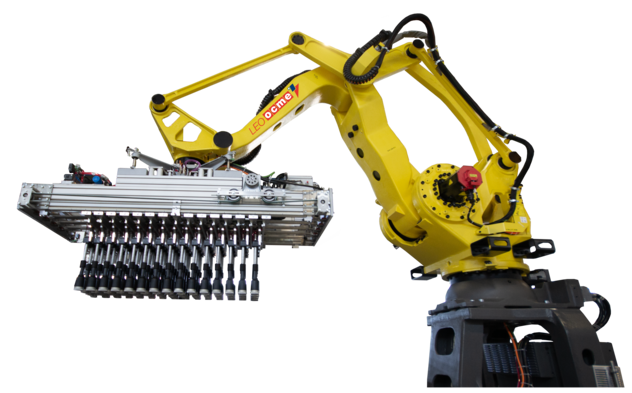
Automated packaging systems, such as high-speed shrink and stretch film packers, robotic palletizers, and laser-guided vehicles (LGVs), can work together. These keep products moving at consistent speeds from the end of the filling line to the warehouse. LGVs are particularly valuable as they eliminate the idle time and traffic unpredictability of manual forklift operations, keeping pallet flow continuous and synchronized with upstream production.
When every stage of the end-of-line system is matched in speed and designed to work as an integrated whole, performance losses shrink considerably.
Quality: Getting It Right Before It Leaves the Line
Quality losses in end-of-line packaging are often underestimated because they don't always show up immediately. Damaged products, mispackaged cases, and unstable pallet loads may pass through the line only to create problems in the warehouse, in transit, or at the retailer. This can generate chargebacks and returns that never get traced back to a specific line event.
Pick-and-place case packers address this by handling fragile or irregular items with the precision that manual processes can't replicate. Automated palletizing ensures consistent load patterns every cycle, reducing the handling errors and instability that drive downstream quality losses.
Sustaining OEE Gains Over Time
Automation delivers the initial OEE improvement, but sustaining those gains requires the right support infrastructure.
Machines degrade, production demands change, and new SKUs get introduced. The manufacturers who retain their OEE improvements are those with on-site support, reliable access to spare parts, and an ongoing relationship with their end-of-line partner.
OEE should be treated as a continuous improvement tool. Tracking it before and after investing in automated packaging systems gives manufacturers a clear picture of what's working and where the next opportunity lies.
Building an End-of-Line System Around Your Target OEE
The most effective industrial packaging machines are engineered around specific line requirements, production environments, and performance targets. That means accounting for your container types, SKU range, changeover frequency, and facility constraints from the start, rather than adapting generic equipment after the fact.
When OEE is the design goal, the results show up in availability, performance, and quality simultaneously. That's the difference between an end-of-line line that runs and one that performs.
Get in touch with OCME USA to discuss how tailored automated packaging solutions can be designed to hit your OEE targets.